
Little Kentucky Farm
Thoroughbred Training and Sales
Race to Sport
Out of the desire to create a horse with speed, endurance and heart, the Thoroughbred breed came to life in England in the 1600’s. Their ancestry derives from three stallions who were brought to England from the Middle East – the Byerly Turk, the Darley Arabian and the Godolphin Arabian.
Breeding from only the best stallions and mares, has produced a rich history that is well documented throughout breeding and racing circles. The first of its kind, the Thoroughbred Stud Book was created by Englishman James Weatherby in the 1700’s. It documents the bloodlines of Thoroughbreds in great detail. It is still being publish today by Weatherbys via England’s Jockey Club.
History shows the first Thoroughbred to come to North America was the stallion Bulle Rock in 1730. Wealthy English and American owners started exporting horses and as the breed’s popularity grew, so did the first volume of the American Stud Book in 1873. It was published by Col. S.D. Sanders of Kentucky, later to be taken over and continues to be published through the Jockey Club.

Dosage Profiling
Do the numbers really mean anything?
Deciphering your ex-racehorse’s Dosage Profile may be part of a missing link and could answer questions as to the type of horse you own. Have you ever sat on a Thoroughbred and wondered what drives them to be the way they are? Do you event a Thoroughbred and feel like your horse could gallop all day long and never tire? Do you have a Thoroughbred that barely needs any conditioning?
Jockey Club registered Thoroughbreds have Dosage Profile numbers that look a lot like lottery numbers. Personally, understanding how to put together a profile is about as interesting as watching grass grow and that old sleepy feeling I use to get while sitting in Statistics class starts to creep in. But by understanding a Thoroughbred’s profile, some may think it can enable them to make predictions about it’s future.
A Dosage Profile (DP) can be thought of as a mathematical equation to classify Thoroughbred pedigrees into different racing categories. It is suppose to assist in verifying what type of race the horse will be successful in running such as a Grade I (Kentucky Derby/Breeder’s Cup), Grade II (Louisiana Derby) or Grade III (Gotham Stakes). The lower level types of races are in the following order: Non-Stakes races, Classified Allowance races, Claiming races, Maiden Special Weight races and Maiden Claiming races.

Profiling predicts inherited traits based upon sire ancestry and how well a horse is going to run in the dirt or on turf, if it will be a sprinter or have stamina to run long distances. The offspring’s sires must be listed on the Chef-de-Race list in order to have Dosage points. Breeders, bloodstock agents and those who bet on races believe it to be a serious tool for rating a horse before it has ever been conceived. It’s an intricate piece of information (that can be confusing), generated by meticulous record keeping and configurations.
The Chef-de-Race list is updated annually and is a ‘who’s- who’ of old and new Thoroughbred sires. The list is sometimes referred to as the Masters of the Breed listing. Each stallion has points that are inherited to their offspring. The points start out higher in the 1st and 2nd generation of foals and gradually become lower in later generations as the sire’s influence or bloodlines lower. For example, 1st generation will be scored 16 points, 2nd generation – 8 points, 3rd generation – 4 points, 4th generation – 2 points. Sires can be named in more than one category and therefore have points in both divisions.
The Dosage Profile’s (DP) 5 categories or 5 numbers, predict the running ability offspring will inherit via the sire/s. The numbers can be found at the top of a Thoroughbred’s pedigree report next to the name, where stallions are placed under the categories of Brilliant (speed) – Intermediate (speed) – Classic (middle) – Solid (stamina) – Professional (stamina). Categories correspond to a range of distance potential. Classic represents the “ideal” balance of speed and stamina and is usually divided in half with points being added into the Brilliant/Intermediate categories and then the other half into the Solid/Professional slot.

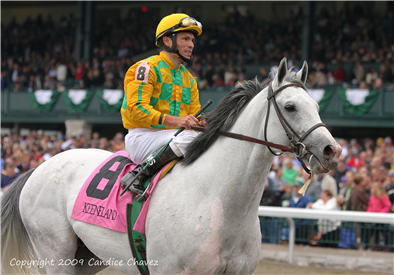
DP = 11-14-13-4-0 (42) DI = 3.00 CD = 0.76
Juddmonte Farms
State Bred: KY
Winnings: 27 Starts: 7 – 6 – 4, $1,849,452
Retired at Old Friends in Kentucky
The Dosage Profile is made up of 2 stats: the Dosage Index (DI) and Center of Distribution (CD). The Dosage Index (DI) is the ratio of inherited proponent speed to stamina in the pedigree. It is derived from the DP by dividing the speed component (the Brilliant points plus the Intermediate points plus one-half the Classic points) by the stamina component (one-half the Classic points plus the Solid points plus the Professional points). The DP is split down the middle through the Classic aptitude group. The numbers on the left side represent speed while those on the right side represent stamina. The Center of Distribution (CD) marks the balancing point of all the numbers in the profile and indicates a specific distance that an individual Thoroughbred can run.
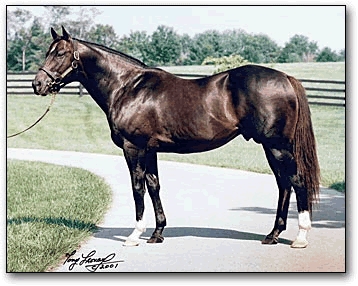
For example, Storm Cat’s highlighted Dosage Profile: (USA) br. H, 1983 DP = 11-8-10-1-0 (30). DI = 4.00 CD = 0.97 . Storm Cat’s Dosage Index interprets him to be a speed horse.
The higher the number is in the Dosage Index (DI) between the scale of 1.0 to 4.0, the more speed a horse is to have. A horse that scores higher than 1.0 for the Center of Distribution (CD) will have lower distance potential.
So the next time you gallop through the finish on Cross Country after having a clean and stellar round, possibly consider your Thoroughbred’s Dosage Profile as playing a part. It could be a hidden formula that gives you a ‘jump’ ahead of the competition.
From Race Horse to Sport Horse
Many new Thoroughbred owners find that their horse is quite different from the Quarter Horse or other breed they had as a child. Taking a horse off the track does require maintenance and an understanding of the racing world in which they’ve lived. Owners will find that their personalities are more prone to be energetic and that their bodies will continue to change physically as they make the transition from a race horse into a sport horse. I often explain to buyers that if you are unable to commit to a schedule of training and work with a Thoroughbred, then do not purchase one. Ex-race horses are likely be the type of horse that is accustom to having a job, and if you cannot invest your time and money into a Thoroughbred, then you need to consider a different breed of horse that would fit into your lifestyle.

I’ve discovered that if you dedicate yourself for 4 to 6 months in putting the time and training into an ex-racer, the payoff will be satisfying for you and the horse. The trick is not to become impatient, take short cuts, become intimidated or lose interest. If there is a knowledgeable horseman with Thoroughbred experience that you trust, I would definitely work with them.
Bermuda and Coastal hay is traditionally known to cause impactions and doesn’t have much nutritional resources. We feed Orchard/Alfalfa hay, Timothy/Alfalfa hay or straight Alfalfa because it helps put on weight and gives the horse an added glow. As for grain, feeding something that is high in fats and feeding the correct amount is very important. Be sure that you balance the amount of food, to the amount of work the horse is in. The metabolism of a Thoroughbred will be higher and they will require more food.
An important note to all horse owners whether they have a Thoroughbred or another breed is to STOP GIVING TREATS! Many people think it’s a nice way of showing the horse affection or think that they can give a treat to reinforce training. Peppermints, carrots, apples, cookies, etc., are some things people give, and I’ve found it generates bad behavior. Begging, pawing the ground, bobbing the head, kicking at the stall walls, getting into your ‘space’, being mouthy and biting or nipping is something handlers can correct – and that is usually when I’m called in to correct the bad behavior.
Horses should stand quietly in the cross ties, should freely walk on a trailer, stand immobile for the farrier, stand immobile while mounting, etc. via consistent handling and use of touch and voice commands. Nothing can tick off a farrier more than to have an owner cramming peppermints down a horse’s mouth and the horse jerking its body around while the farrier struggles to keep their composure and temper.

In the morning with work outs and prepping for the day’s upcoming race, the horses will be handled by a variety of people hired on the team. They’ll be with the groom, the exercise rider, the trainer and stall workers. Taking the time to watch your horse’s habits and getting to know their personality will help you understand their individual characteristics, and you can see if they are girthy, if they’re possessive of their stall space or if they enjoy interacting with people.
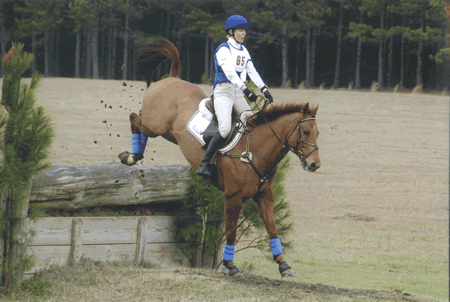
Some Thoroughbreds will have been stabled at the track for many weeks, walking on the hot walkers and not be able to graze or have turnout time in a pasture. Be careful of the amount of time you let them graze for the first week. They’re not use to grass and you may see their manure will be very runny. The next thing to watch out for is that they may become body sore from the sudden ‘freedom’ they’re allowed to have in the field. They’re also more prone to loosing shoes if they’re running around, so make sure their shoes have clips to help secure them.
At the track, the horses are not shod with clips, but rather light aluminum racing shoes. When replacing their shoes with those that have clips, be careful as to how tight your farrier makes them. Tight clips will initially make their hooves sore. Thoroughbreds can be more active in the fields, so my horses go out with bell boots and splint boots as a precautionary.
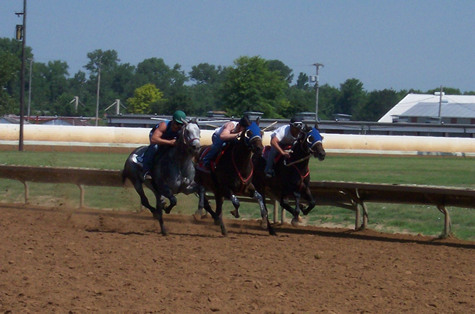
The Thoroughbreds for sale at the farm are quality horses. What sets these horses apart from others is not only their correct conformation, soundness and ability, but the fact that they are well represented. We take great pride in our Thoroughbreds and are confident in our training and care to have them become successful athletes.

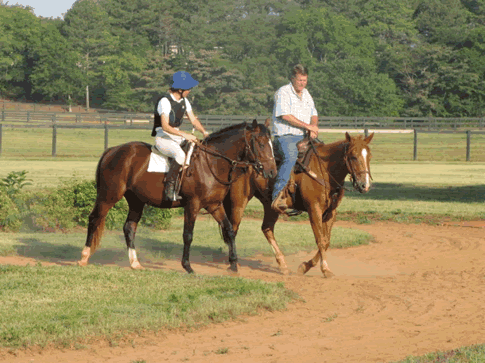


 Little Kentucky Farm